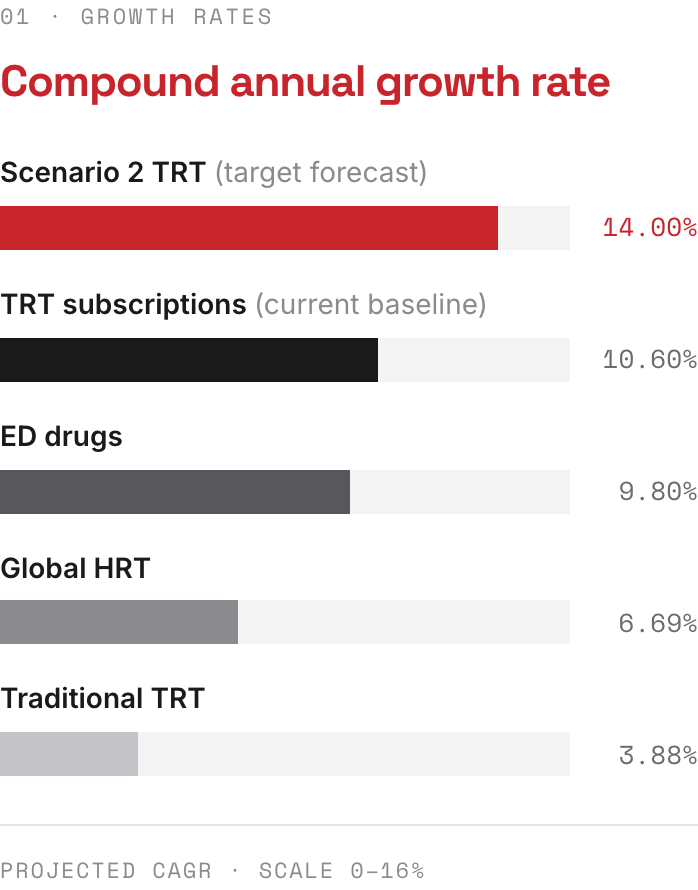
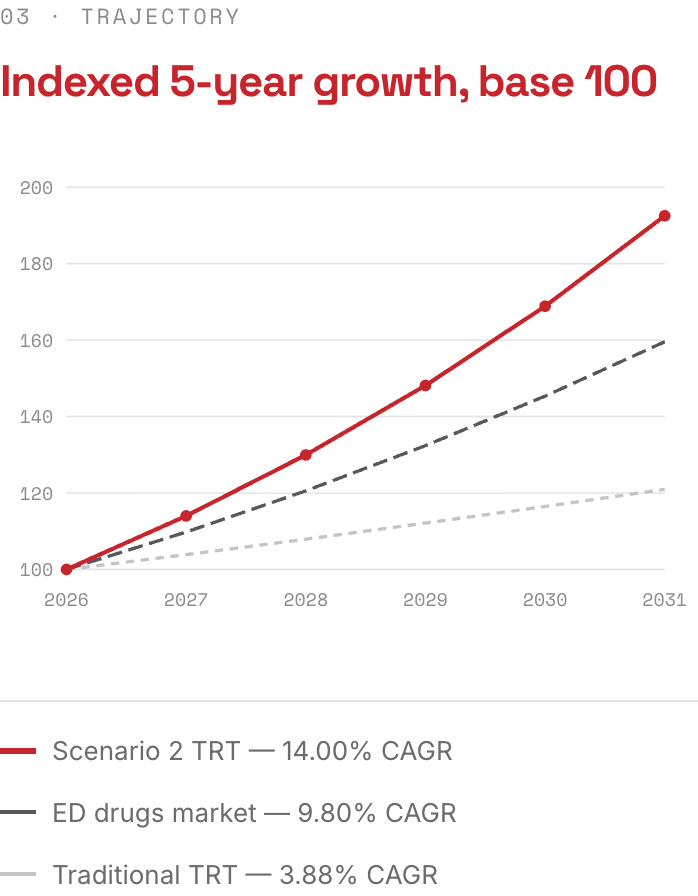
For years, institutional market analyses pegged the traditional global testosterone replacement therapy market to a slow, uninspired trajectory—crawling at a modest 3.88% CAGR. Under those legacy clinical frameworks, the US sector was paced for nominal gains, bound tightly by the pre-pandemic restrictions of the Ryan Haight Act which required mandatory face-to-face clinical evaluations for Schedule III controlled substances.
The macro-projections of the early 2020s are officially obsolete.
Driven by consecutive federal interventions in early 2026, the US TRT market has broken away from traditional pharmaceutical metrics. By evaluating the structural forces currently at play, we can model the 5-year scaling trajectory of the online TRT subscription economy and identify why a highly accelerated expansion is the most probable macro-outcome.
The 5-Year US TRT Revenue Forecast Matrix (2026–2031)
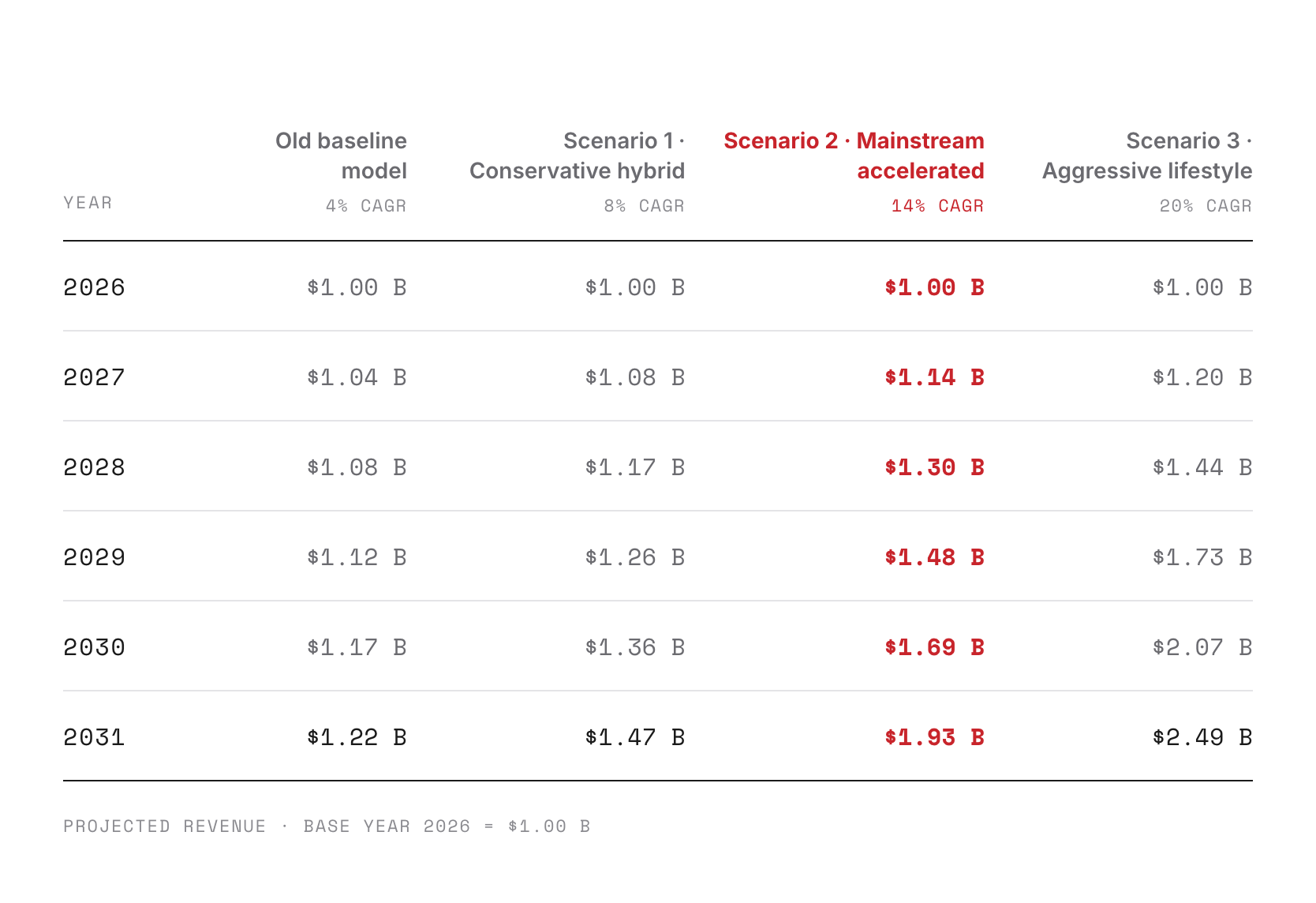
Grounded on an initial $1.00 Billion US market cap baseline for specialized hormone delivery channels, the following matrix models three distinct five-year trajectories based on regulatory execution:
Why Scenario 2 (14% CAGR) is the Most Likely Outcome
While a jump from a historical 4% run rate to a sustained 14% CAGR appears aggressive on paper, a multi-variable analysis proves that Scenario 2 ($1.93 Billion by 2031) is the most statistically sound base case. This trajectory is driven by three powerful macro-forces:
Force 1: The Blueprint of Mature Peer Verticals
We know double-digit compounding growth is achievable because the direct-to-consumer digital subscription blueprint has already been validated by peer categories in men's and women's health.
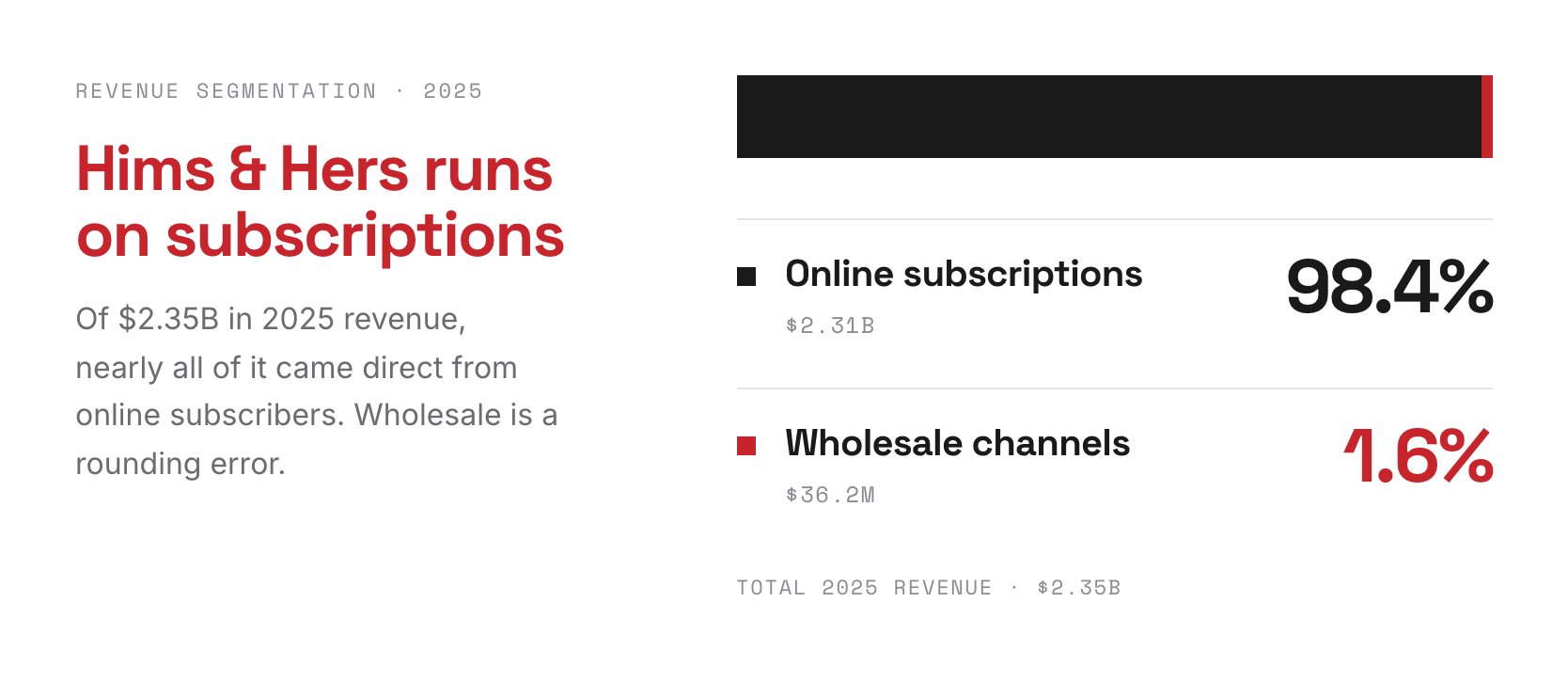
Look at the financial engine of Hims & Hers Health, Inc.: The company scaled its top-line revenue from $82.56 million in 2019 to an astounding $2.35 billion in 2025—marking a massive 59% year-over-year increase from 2024.
Crucially, 98.4% of that revenue ($2.31 Billion) was generated entirely through online recurring subscription models, while legacy wholesale distribution shrank.
Furthermore, market data reveals that the global specialized Testosterone Therapy Subscription Market was already maintaining a structural 10.6% CAGR baseline ($3.8B in 2025 pacing to $9.4B by 2034) prior to recent updates. Pushing the US model to a 14% CAGR simply accounts for the massive, unbaked consumer demand unlocked by the June 2026 federal directives.
Force 2: Eradication of Prior Authorization Barriers
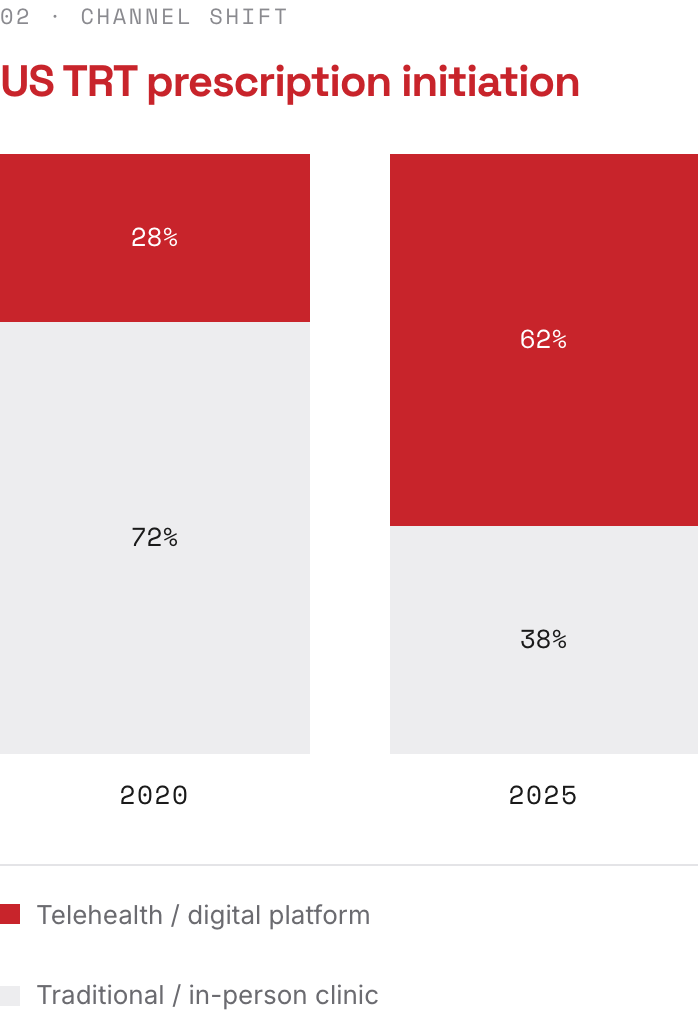
Historically, the primary barrier preventing mass-market TRT expansion wasn't consumer interest—it was institutional friction. The old 2015 FDA label rules blocked mainstream primary care physicians (PCPs) from prescribing testosterone for natural, age-related declines. This gave commercial insurance companies a default mechanism to issue automated prior authorization denials, forcing virtual platforms to operate as high-friction, out-of-pocket cash models.
By completely striking the age-related limitation from class-wide labeling, HHS has dismantled this barrier. Mainstream clinicians now possess clear federal cover to treat idiopathic hypogonadism safely, and private insurance providers are stripped of their primary medical justification for coverage denials. As commercial reimbursement pathways open up, TRT will rapidly transition from an insulated lifestyle niche into standard, mass-market preventive healthcare.
Force 3: Stabilization of the Telemedicine Prescribing Framework
A major variable capping downside risk in Scenario 2 is the DEA’s structural regulatory transition. The implementation of the Fourth Temporary Extension formally preserved all remote prescribing flexibilities for controlled substances through December 31, 2026.
More importantly, the proposed permanent Special Registrations for Telemedicine framework introduces a clear, standardized pipeline for Schedule III medications. Because testosterone is a Schedule III substance, it completely bypasses the severe federal crackdowns targeted at Schedule II stimulants and narcotics.
While digital platforms will face minor trailing margins to establish mandatory state-level data reporting and Prescription Drug Monitoring Program (PDMP) integrations, the survival of pure-play remote onboarding ensures that digital customer acquisition channels remain highly efficient.
Macro-Conclusion
The blending of recurring digital subscription architecture with complete federal de-escalation means the US TRT market is poised to near-double the old institutional models, capturing an additional $710 Million in net sector revenue by 2031.
The growth will not be linear. Expect a minor margin contraction in 2027 as operators build out the infrastructure required for permanent DEA platform registrations, followed by an aggressive vertical acceleration through 2031 as mainstream health systems launch dedicated longevity layers to absorb the massive wave of newly eligible American consumers.