A massive regulatory shift just blew the doors off the men’s health market. Here is why the race to cash in is about to spark a wave of catastrophic brand meltdowns—and how the smart money is surviving.
The federal government just handed the keys to a massive vault to the hormone optimization space.
By executing a sweeping, class-wide rewrite of the highly restrictive rules governing testosterone replacement therapy (TRT), HHS and the FDA have fundamentally flipped the unit economics of men’s health. Overnight, a heavily gatekept medical niche has been transformed into a massive lifestyle longevity play, giving telehealth platforms, creative agencies, and health attorneys a massive growth lever.
But don't pop the champagne just yet. Behind every great gold rush is a graveyard of companies that ran too fast without a map. While the legal definition of who can get therapy is expanding, the actual execution layer—the ad platforms, algorithmic content filters, and credit card processing networks—is about to become an absolute minefield.
1. The Playbook of Hyper-Growth
Whenever structural regulatory friction is stripped away from a high-demand health category, the market doesn't just grow—it experiences a sharp, violent vertical spike. We’ve seen this exact movie play out before in the digital health boom, and the sequel is about to be even bigger.
The Menopause Boom
- The Blueprint: For decades, female hormone replacement therapy was suppressed by outdated safety warnings.
- The Shift: When modern, safer delivery methods opened up the market, it exploded into a booming $17 billion digital industry.
- The Unicorn: First-mover Midi Health scaled its revenue over sixfold in just two years, captured a $100 million Series D funding round, and locked in a valuation crossing the $1.0 billion mark.
The Great ED Disruption
- The Blueprint: Men's sexual health used to be locked behind the clinical, heavily stigmatized doors of local urology offices.
- The Shift: The arrival of cheap generics combined with a patchwork of state laws allowing online questionnaires changed everything.
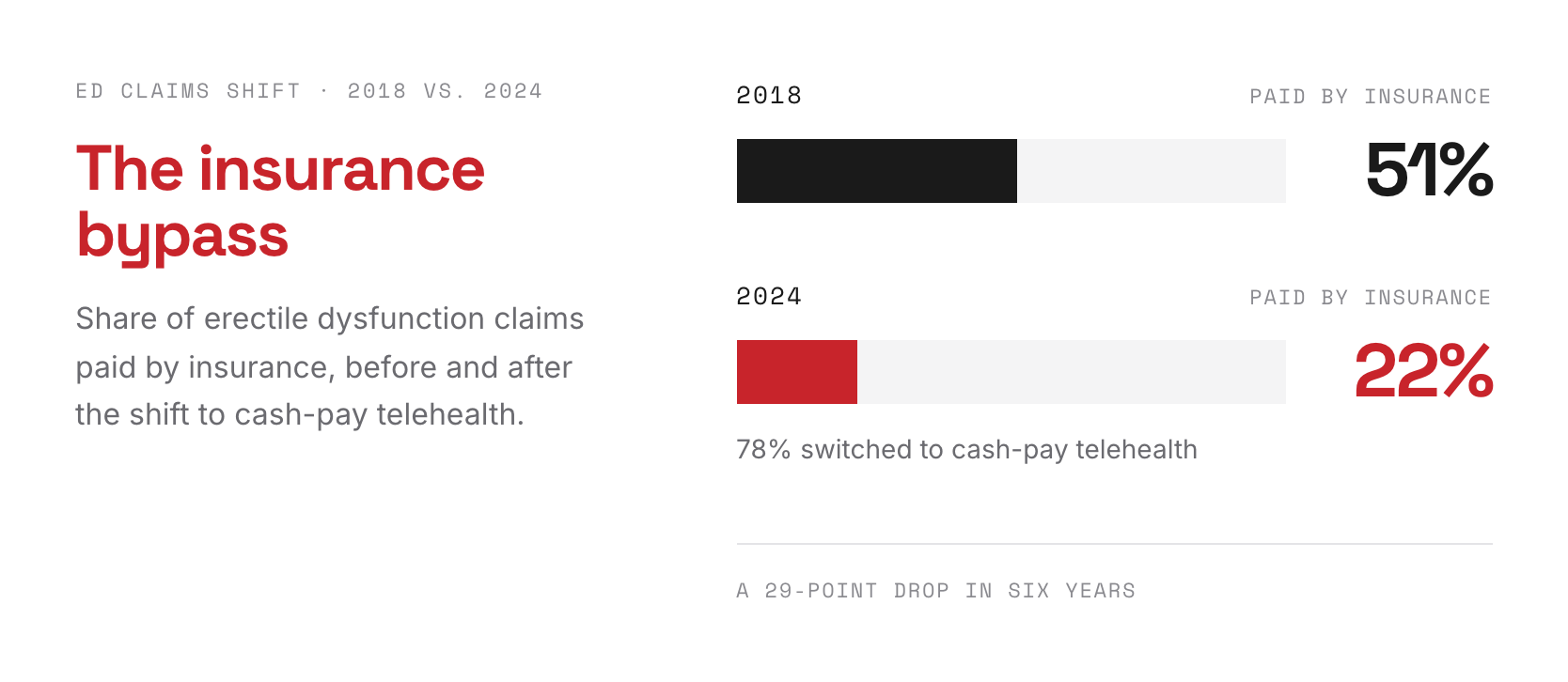
- The Flip: Commercial insurance claims for erectile dysfunction plummeted from 51% in 2018 down to a tiny 22% by 2024.
- The Margin: Guys willingly skipped the insurance nightmare to buy frictionless cash-pay subscriptions online. This allowed platforms to buy generic molecules for pennies, sell them for $0.50 to $6.50 per dose, and build multi-billion-dollar empires.
The TRT Launchpad
TRT is stepping onto an even bigger launchpad. The consumer behavior is already deeply ingrained: by 2025, a staggering 62% of all new TRT prescriptions in the U.S. were already being initiated through a telehealth platform.
The catch was that these platforms were historically crammed into a restrictive legal box. Old rules dictated that testosterone could only be prescribed for rare genetic or structural medical disorders; the labels explicitly banned marketing it for "age-related" decline.
By completely removing that age-related restriction, the federal government has opened the floodgates. TRT is officially transitioning from a high-friction niche into a mainstream, daily longevity routine for millions of aging Americans.
2. The Catch: The Execution Minefield
The immediate temptation for performance agencies and founders will be to flood Meta, Google, and TikTok with thousands of shiny new ad variants screaming about "vitality," "libido," and "anti-aging."
And that is exactly how these brands will self-destruct.
The brutal reality of the digital health space is that a severe, systemic lag exists between federal policy changes and commercial ad platform enforcement.
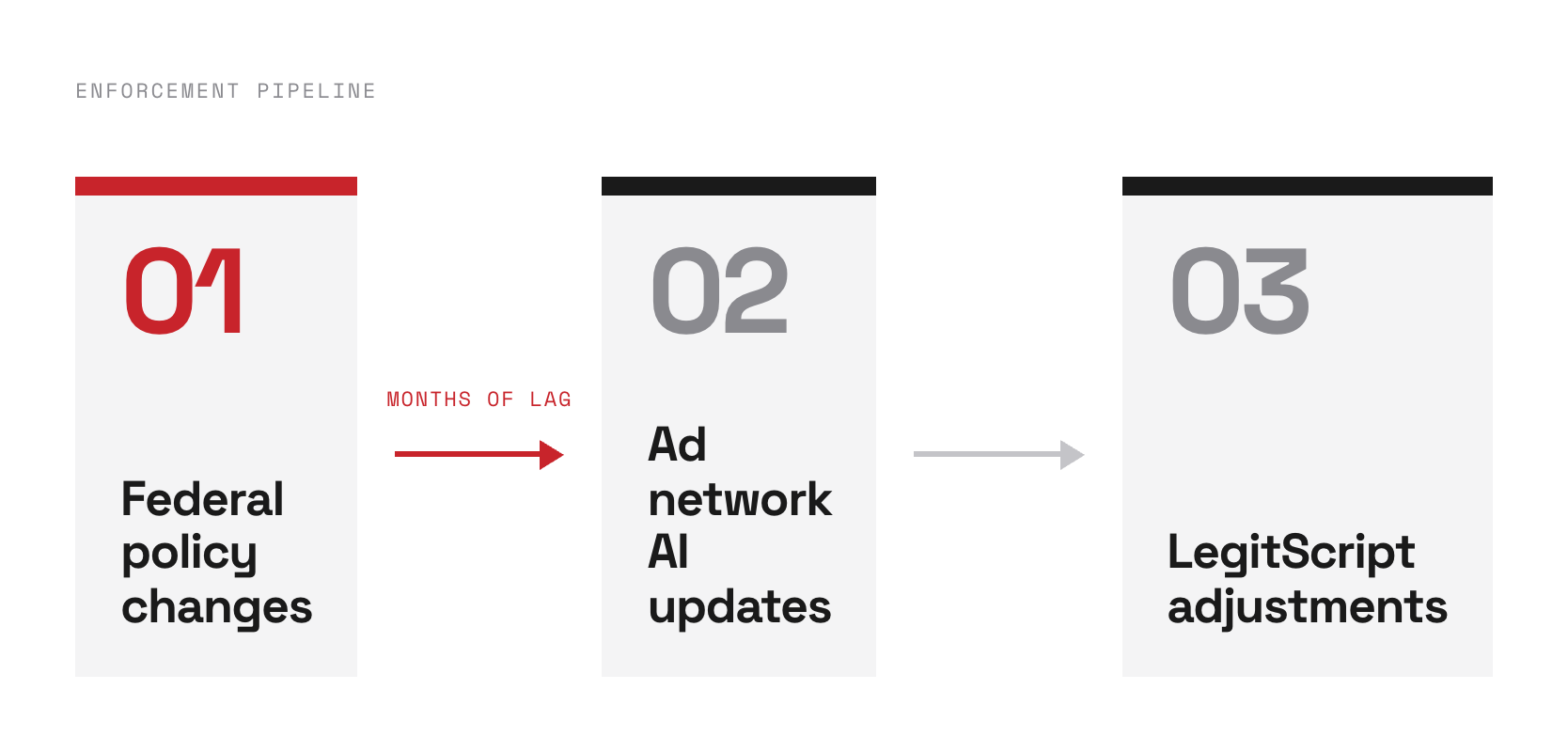
- The Algorithmic Ambush: Meta and TikTok’s automated ad terminators do not read government PDFs the day they are released. Their AI models are still hardwired to flag, reject, and permanently ban accounts that market controlled substances with aggressive lifestyle hooks.
- The Payment Freeze: LegitScript remains the ultimate gatekeeper for visa and mastercard processing. If your brand pushes the creative boundary too fast before card networks update their compliance mandates, you will trigger immediate merchant account freezes and catastrophic cash-flow disruptions.
- The State-Level Squeeze: While federal rules have extended remote prescribing flexibilities through the end of 2026, individual states are quietly fighting back. For instance, New Jersey recently passed a strict statute permitting telemedicine prescribing of controlled substances only after an initial in-person exam, with mandatory face-to-face follow-ups every three months. Ohio has rolled out similarly restrictive barriers.
- The Enforcement Reality: Regulators are actively looking for examples. Telehealth provider The Pill Club was hit with a brutal $15 million settlement in California for taking shortcuts with automated questionnaires and lax consultations. Meanwhile, a recent study published in JAMA Internal Medicine revealed that 85.7% of evaluated DTC testosterone platforms were caught handing out guideline-discordant prescriptions to patients who didn't even clinically qualify.
As the regulatory spotlight intensifies, manual compliance checks simply cannot scale against automated ad filters and aggressive state medical boards.
3. The Secret Weapon: Lava
In a landscape where the rules are fluid and enforcement is entirely automated, relying on manual reviews is a critical liability. You cannot scale a modern consumer health brand using spreadsheets and a team of stressed-out lawyers trying to read thousands of lines of ad copy.
You need a software-driven shield. You need Lava.
Lava is the ultimate translation layer sitting between your growth team's medical marketing intent and the ad network's automated filters. It instantly reads your creative copy against a massive, updated matrix of FDA guidelines, FTC orders, LegitScript standards, and state-by-state telemedicine laws—flagging exactly what will trip a filter, explaining why, and suggesting a compliant rewrite before you hit launch.
- For Telehealth Operators: Lava helps mitigate the compliance risks facing your most valuable digital assets—your ad accounts and your payment processing. It empowers your marketing team to deploy and test a wider volume of campaign angles while significantly minimizing the exposure to sudden, business-disrupting account bans.
- For Creative Agencies: Speed and volume are your currency. Lava enables your creative teams to explore impactful angles and hooks with a built-in compliance guardrail, pre-screening copy against known programmatic triggers before it ever hits a review queue. This allows you to safely scale your output while actively minimizing compliance vulnerabilities for your clients.
- For Healthcare Lawyers: High-volume creative review shouldn't be a manual bottleneck that caps your capacity. Lava acts as an automated co-pilot, streamlining the preliminary screening of complex client campaigns. It handles the initial heavy lifting across mountains of creative assets, allowing you to scale your review capacity and mitigate human error before adding your final, software-backed legal stamp.
The TRT market is experiencing a historic structural unlock. The brands, agencies, and legal teams that dominate this next phase won't just be the ones with the deepest pockets—they will be the ones using Lava to out-pace, out-market, and out-comply the competition.