Your copywriter swears the text is 100% accurate. Your regulatory attorney gave it the green light. So why did Meta just permanently disable your advertising account?
In the direct-to-consumer (DTC) telehealth sector, there is no greater tech-stack crisis than the dreaded "Ad Account Restricted" notification. For growth-stage platforms, social ad accounts are the oxygen that fuels patient acquisition. When they go dark, growth flatlines.
What drives healthcare founders and performance agencies to madness is the apparent randomness of these account bans. You review the rejected creative asset. The copy contains no banned substances, makes no explicit medical promises, and completely avoids deceptive keywords.
You appeal the decision, confident it's a glitch in the algorithm. The appeal is denied.
The underlying issue isn’t a flaw in Meta’s machine learning. Rather, your growth team has likely fallen into one of the most sophisticated regulatory bottlenecks in modern advertising: The FDA and FTC Net Impression Doctrine. And in 2026, ad network AI models are being trained to enforce it with zero leniency.
What is the "Net Impression" Trap?
Many growth marketers operate under a false assumption: as long as every individual sentence in an ad is literally true, the ad is legally compliant.
The regulatory bodies that govern consumer health—the FDA and the FTC—do not look at advertisements as a collection of isolated sentences. Instead, under long-standing truth-in-advertising laws, these agencies evaluate the "net impression" of the entire piece.
Net impression is the overall takeaway an ordinary consumer extracts from the asset. It is calculated by looking at the total context: the text, the background music, the pacing, the models' expressions, and the visual graphics combined.
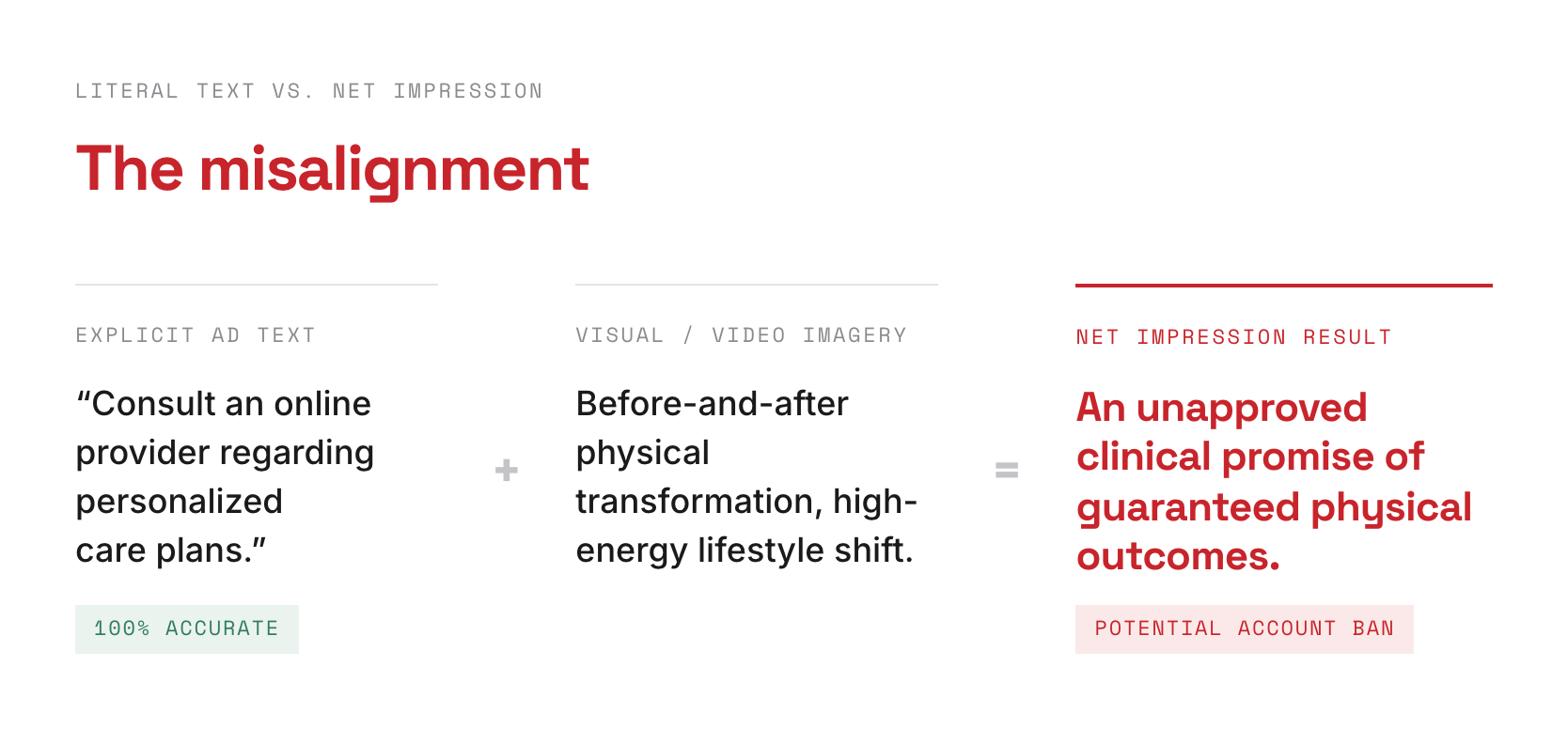
This creates a hidden trap for telehealth platforms. If your ad features literally accurate text about a baseline hormone optimization program, but couples that text with a background video of someone experiencing dramatic weight loss or a sudden reversal of aging, the net impression is an unapproved, implied efficacy claim.
Under federal law, an implied claim carries the exact same legal weight as an express claim. If you cannot substantiate that broader, implied outcome with rigorous, human-clinical trials, your literally true ad is legally classified as deceptive advertising.
The New Algorithmic Enforcers
Historically, enforcing net impression required a human regulator to manually review a commercial and issue a warning letter. But as digital health ad spend has surged over the past few years, major ad networks like Meta, Google, and TikTok have faced intense pressure to clear unapproved medical claims from their feeds.
To protect themselves from federal scrutiny, these platforms have upgraded their automated content review systems. They no longer just run basic text-string checks for prohibited drug names. Modern ad-review algorithms utilize multimodal AI that analyzes the interaction between the words on screen and the video files attached to them.
If the algorithm detects a mismatch—where a conservative medical statement is paired with an aggressive lifestyle visual—it automatically flags the asset for a "misleading net impression" violation. Because ad networks prefer to err on the side of caution, these flags frequently result in instant ad rejections or permanent account suspensions.
Moving Beyond the Manual Bottleneck
For performance creative agencies, this presents a massive operational challenge. To stay competitive, your media buyers need to continuously test new visual hooks, user-generated content (UGC) variations, and landing page designs.
However, your compliance attorneys cannot realistically review every permutation of a video asset to assess how a visual frame might subtly alter the net impression of a headline. Relying entirely on manual legal review creates an expensive bottleneck that throttles your scaling capacity.
Lava: A Software Guardrail for Complex Creative
To navigate an environment where enforcement is entirely automated, growth teams require automated compliance guardrails. This is where an intelligent compliance tool like Lava can serve as an essential part of your marketing infrastructure.
Lava is designed to act as a programmatic safety net that bridges the gap between your creative team's intent and the ad network's automated filters. By evaluating marketing copy against a continuously updated matrix of FDA warning letters, FTC compliance guides, and ad network policy updates, Lava helps media buyers identify problematic context before it ever reaches the platform review queues.
- For Telehealth Operators: Lava helps mitigate exposure for your primary customer acquisition pipelines. By screening copy variations for underlying structural or implied claims, it helps significantly reduce the risk of an unexpected, account-disrupting Meta ban.
- For Performance Agencies: Lava provides your design teams with clear, programmatic guardrails. It detects when phrasing leans too heavily into implied outcomes and suggests alternative, compliant rewrites. This enables your team to launch impactful, high-converting creative angles while actively minimizing compliance vulnerabilities for your clients.
- For Healthcare Counsel: Lava assists with the heavy lifting of high-volume asset screening. By automating the preliminary checks across hundreds of copy variations, it helps to minimize human error, allowing you to add your final legal approval stamp with higher efficiency and software-backed precision.
In the modern digital health landscape, the brands that scale sustainably aren't the ones playing regulatory roulette with their ad accounts. By implementing programmatic tools to manage the nuances of the net impression doctrine, telehealth brands can safely deploy high-performing campaigns while minimizing their regulatory exposure and keeping their acquisition engines running smoothly.