A winning ad campaign in Florida could be an explicit compliance violation in New Jersey. For telehealth brands expanding nationwide, the biggest threat to scale isn't ad fatigue—it’s geographic fragmentation.
Every ambitious telehealth founder reaches the same inflection point. You’ve validated your medical offering in a few initial states. Your unit economics are pristine, your clinical operations are smooth, and your growth team is ready to scale.
So, your media buyer logs into Meta Ads Manager, changes the geographic targeting from a few select states to "United States - Nationwide," and hits publish.
To a digital marketer, the U.S. is one giant, unified pool of consumers. But to a healthcare attorney, it is a fractured landscape of 50 entirely separate legal jurisdictions, each governed by its own medical board, its own administrative code, and its own highly specific rules on how healthcare services can be marketed.
As digital health platforms expand their footprint in 2026, running a single, un-localized national ad strategy has become a direct route to triggering state-level regulatory investigations.
The Illusion of Federal Uniformity
Many direct-to-consumer (DTC) health brands lean heavily on federal guidelines to inform their compliance roadmaps. For instance, platforms prescribing hormone optimization therapies often focus on the DEA's current federal parameters, such as the Fourth Temporary Extension, which extended remote controlled-substance prescribing flexibilities through December 31, 2026.
But federal allowance does not equal state-level approval. While federal rules may grant temporary breathing room, individual state medical boards are aggressively asserting their sovereign authority over the practice of telehealth within their borders.
Consider the compliance divergence sweeping the country:
- The In-Person Mandate: Effective February 16, 2026, New Jersey enacted a strict statute permitting the telemedicine prescribing of certain controlled substances only after an initial in-person evaluation, with mandatory face-to-face follow-ups every three months. Ohio and several other states have rolled out similarly restrictive measures.
- The Asynchronous Divide: Some states broadly welcome asynchronous care (questionnaire-only onboarding), while others strictly define a valid patient-provider relationship as requiring a synchronous audio-video interaction.
- The Disclaimer Trap: Multiple states mandate specific, localized disclosures regarding corporate practice of medicine, patient grievance hotlines, or provider licensure status that must be visible to the consumer prior to onboarding.
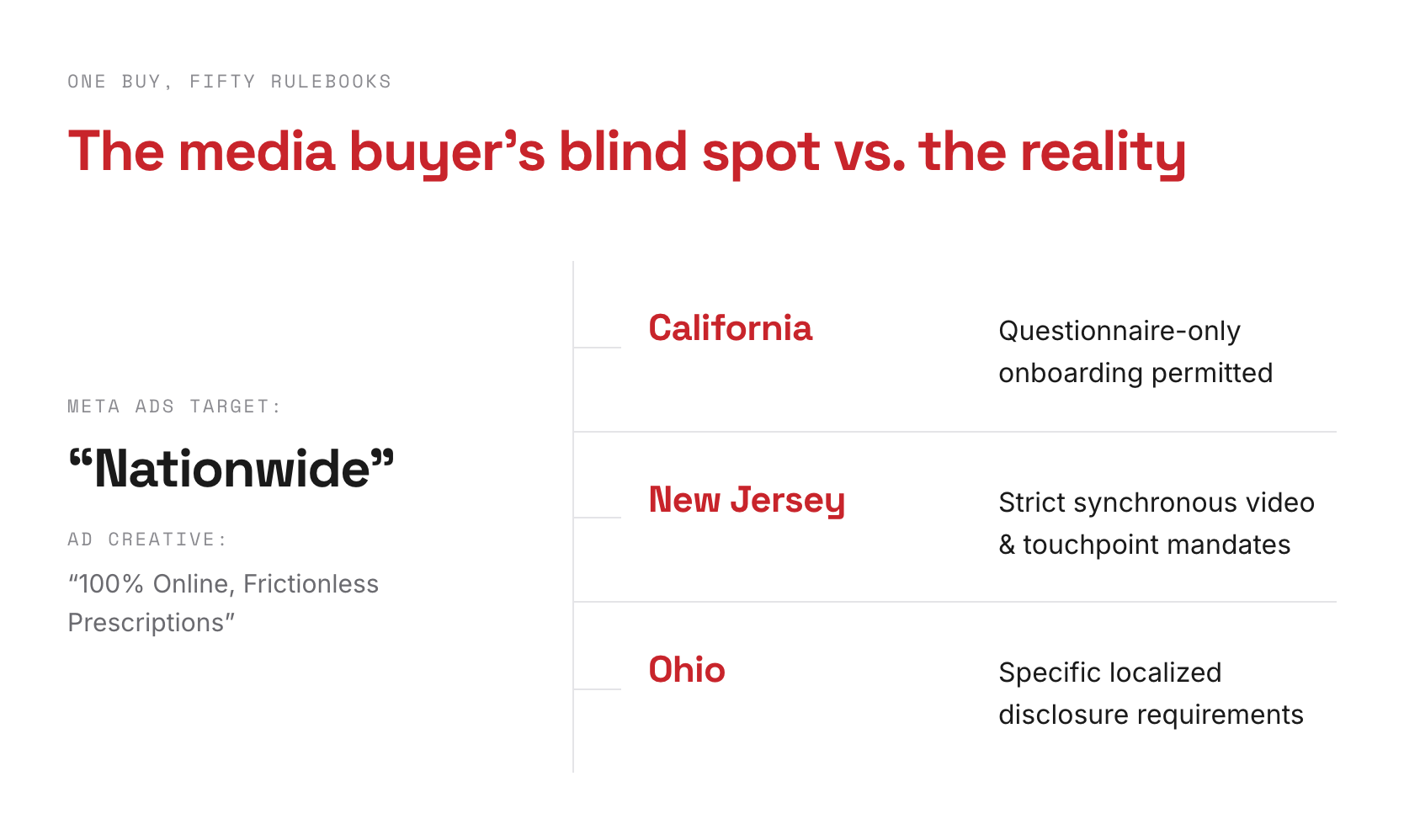
If your nationwide ad creative promises "100% Online, Frictionless Prescriptions" or "Get Treated in Minutes Without a Video Call," you are explicitly marketing a clinical workflow that is non-compliant in several of the states your ads are targeting.
Why Marketing Copy Triggers Medical Boards
State medical boards do not just discipline physicians behind closed doors; they actively police the professional conduct and public-facing claims of corporate medical entities operating within their jurisdictions.
When a media buyer launches a high-volume campaign, they are pushing creative assets directly into the feeds of millions of consumers—and inevitably, state investigators and competing health systems. If an ad copy implicitly or explicitly misrepresents the legal clinical process required in a specific state, it can be categorized as misleading advertising or the unauthorized practice of medicine.
The consequences go far beyond a rejected ad. A single state-level medical board investigation can halt your operations, trigger reciprocal investigations in other states, tie up your executive team in months of costly administrative litigation, and severely damage your brand's reputation ahead of institutional funding rounds.
The Scaling Bottleneck: Speed vs. Localization
For growth-focused performance agencies, this creates an operational nightmare. To combat ad fatigue and maintain efficient acquisition costs, a creative team needs to test dozens of new copy hooks, angles, and landing page layouts every week.
However, your internal legal counsel cannot manually review, edit, and localize hundreds of localized creative iterations across 50 different states simultaneously. Relying strictly on manual legal review creates an expensive, sluggish bottleneck that effectively kills your speed-to-market and cripples your ability to scale nationwide.
Enter Lava: Your Localized Compliance Guardrail
Navigating a highly fragmented regulatory landscape at the speed of modern programmatic advertising requires an automated solution. This is where an intelligent compliance tool like Lava can serve as an indispensable layer of your growth infrastructure.
Lava is designed to act as a programmatic safety net that sits directly between your creative team's marketing workflows and the fragmented web of state-level regulations. By cross-referencing your digital ad copy and landing page assets against a continuously updated matrix of state medical board statutes, FDA regulations, and FTC orders, Lava flags localized compliance risks before your campaigns go live.
- For Telehealth Operators: Lava helps mitigate regulatory exposure during aggressive geographic expansion. By programmatically screening copy variations against state-specific rules, it helps significantly reduce the risk of accidentally running an non-compliant ad that catches the attention of a strict state medical board.
- For Performance Agencies: Lava provides your media buyers and copywriters with clear, real-time guardrails. It detects when generalized, high-converting hooks cross the line into localized compliance violations and suggests alternative, compliant rewrites. This allows your team to maintain high creative velocity while actively minimizing compliance vulnerabilities for your clients.
- For Healthcare Counsel: Lava assists with the heavy lifting of multi-state asset screening. By automating the preliminary verification process across hundreds of dynamic variations, it helps to minimize human error, allowing your legal team to focus on high-level corporate strategy while maintaining software-backed oversight.
The telehealth brands that successfully dominate the national stage won't just be the ones throwing the most capital at ad platforms. They will be the ones that build a resilient, software-driven infrastructure capable of out-complying the competition. By utilizing programmatic guardrails to navigate the multi-state minefield, you can aggressively scale your ad spend nationwide while minimizing your regulatory exposure and protecting your business.