The U.S. Department of Health and Human Services (HHS) and the FDA have fundamentally transformed the unit economics of men’s health. By executing a sweeping class-wide rewrite of the highly restrictive testosterone replacement therapy (TRT) labeling rules, the federal government has effectively handed telehealth operators, performance agencies, and healthcare attorneys an un-gatekept commercial growth lever.
But behind this explosion in Total Addressable Market (TAM) lies a catastrophic operational trap. While the legal definitions are expanding, the execution layer—ad platforms, algorithmic content filters, and merchant compliance networks—is about to become an absolute minefield.
1. Grounding the Potential: The "Deregulation Multiplier"
Whenever structural regulatory friction or restrictive labeling is removed from a high-demand medical category, the market experiences a sharp, predictable vertical spike. We can project TRT's imminent growth trajectory by mapping it against clear industry precedents where regulatory gates were lifted:
Case A: The Menopause HRT Blueprint
- The Gate: For over two decades, menopausal hormone therapy (MHT) was suppressed by broad FDA "black box" warnings imposed following an outdated interpretation of historical safety studies.
- The Deregulation: Driven by a multi-year shift recognizing the safety profiles of modern transdermal and non-oral delivery systems, the FDA executed a massive unwinding of these class-wide warnings. By early 2026, the first clean, rewritten product labels hit the market.
- The Multiplier Effect: This shift catalyzed an unprecedented wave of consumer adoption. Virtual providers in this space quickly consolidated an underserved market, turning perimenopause and menopause digital care into a booming $17 Billion industry. First-movers like Midi Health scaled over sixfold in a tight two-year window, closing a massive $100 million Series D funding round in February 2026 to achieve a $1.0 Billion+ valuation.
Case B: The ED Digital Expansion
- The Gate: Hard clinical boundaries and heavily stigmatized prescribing criteria meant men's sexual health treatment was tightly localized to urologists and risk-averse brick-and-mortar primary care networks.
- The Deregulation: The transition of key molecules like sildenafil to generic availability intersected with state-level medical boards expanding asynchronous telehealth rules (pioneered by frameworks like the Utah Online Prescribing Act).
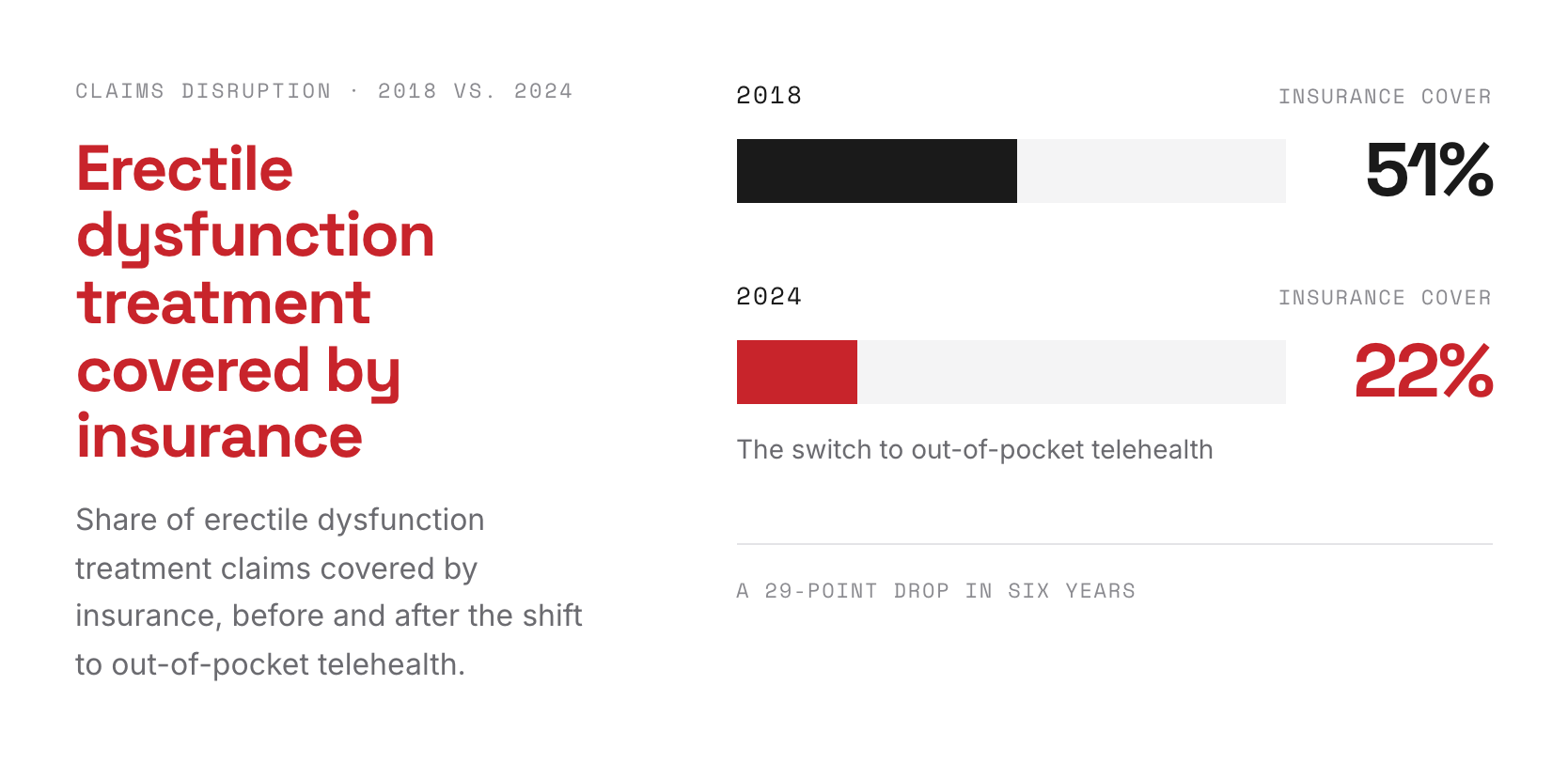
- The Multiplier Effect: Removing that single logistical friction point unlocked a massive consumer cohort. It triggered a profound structural shift in how health services are financed: commercial insurance coverage for ED prescription claims plummeted from 51% in 2018 to just 22% by 2024 as patients willingly chose cash-pay virtual subscriptions over insurance barriers. This allowed vertically integrated platforms to capture pristine margins by shipping low-cost generics ($0.50 to $6.50 per dose) straight to consumers. The global ED drugs market scaled rapidly to a $3.2 Billion baseline on its way to a projected $6.6 Billion by 2033.
Projecting the TRT Boom
TRT is starting from a much higher baseline. Unlike early ED or HRT, telemedicine has already captured consumer behavior here: in 2025, approximately 62% of all new TRT prescriptions in the United States were initiated through a telehealth platform, up from just 28% in 2020.
However, those prescriptions were historically crammed into a restrictive legal box. Under the old rules, TRT was strictly indicated for structural or genetic hypogonadism; labels explicitly stated safety had not been established for "age-related" decline. By removing the age-related restriction entirely and narrowing prostate cancer contraindications solely to metastatic cases, HHS has opened the floodgates.
If removing the menopause HRT warnings unlocked a multi-billion dollar vertical, and ED deregulation created a massive cash-pay subscription economy, freeing TRT from the "age-related" restriction will easily push the sector from its baseline into a mainstream, mass-market longevity category.
2. The Danger Zone: Why Risks are Higher Than Ever
The temptation for operators and agencies over the next 6 months will be to immediately launch a massive volume of consumer-facing ad variants focusing on "vitality," "libido," and "age-related decline."
This is where companies will go under. While the FDA has adjusted its stance, a severe systemic lag exists between federal policy and commercial ad platform enforcement:
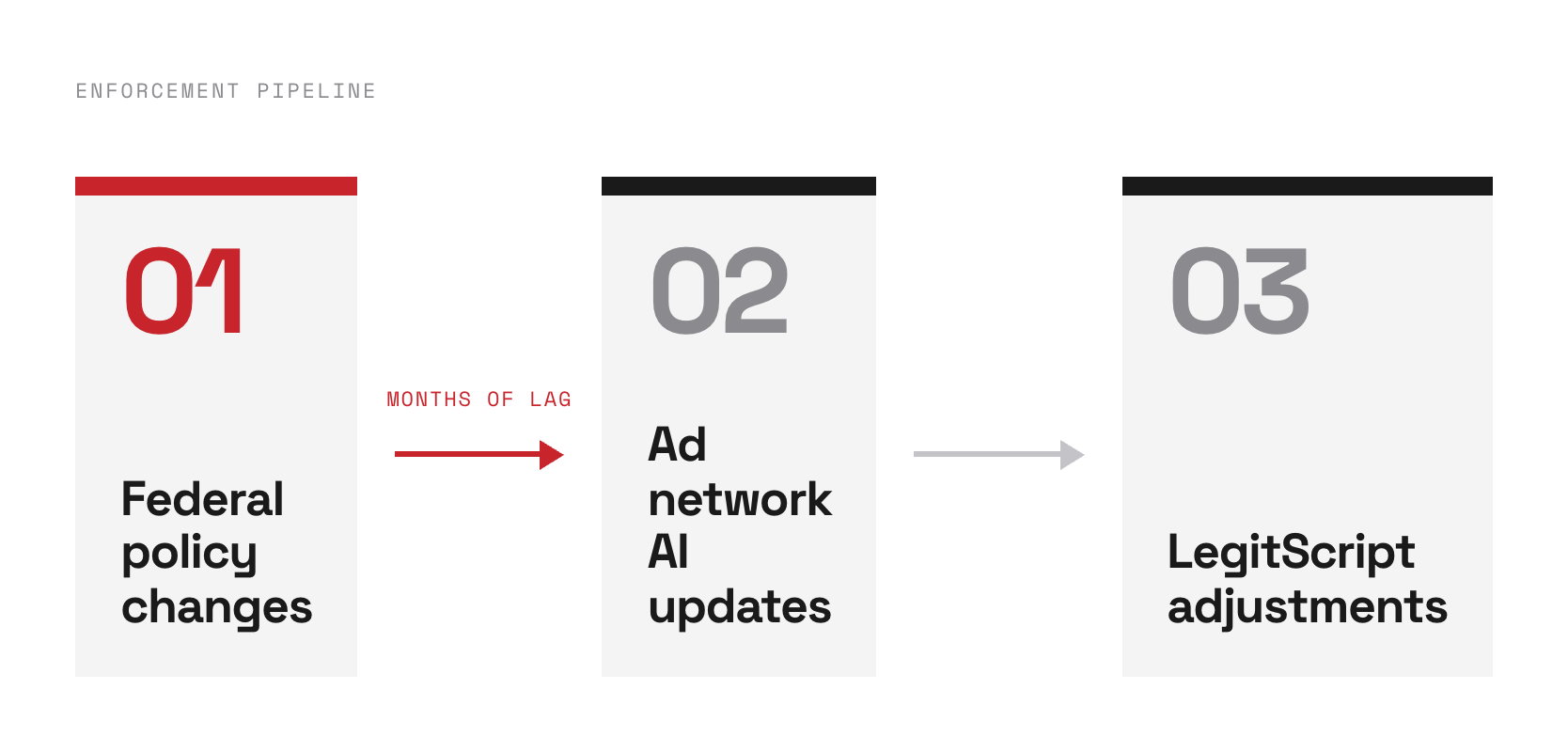
- The Algorithmic Lag: Meta, Google, and TikTok do not update their automated content review systems the day a government agency releases a PDF. Their AI models are still aggressively trained to flag, reject, and permanently ban accounts that market controlled substances with lifestyle hooks.
- The LegitScript Bottleneck: LegitScript remains the ultimate gatekeeper for payment processing. If a brand pushes the boundary too fast before card-network mandates catch up, it triggers immediate compliance audits, merchant account freezes, and devastating cash-flow disruptions.
- The State-Level Squeeze: While federal rules under the DEA's January 2026 Fourth Temporary Extension allow remote prescribing of controlled substances through December 31, 2026, individual states are clamping down. Effective February 16, 2026, New Jersey enacted a statute permitting the telemedicine prescribing of Schedule II substances only after an initial in-person exam, with mandatory in-person follow-ups every three months. Ohio and other states are asserting similar tightening.
- The Enforcement Reality: Federal and state regulators are actively watching. Look no further than the $15 Million settlement California extracted from online telehealth provider The Pill Club for relying on inadequate virtual consultations and automated questionnaires to issue prescriptions. Furthermore, a secret shopper study published in JAMA Internal Medicine revealed that 85.7% of evaluated DTC testosterone platforms prescribed guideline-discordant care to investigators presenting with normal hormone levels, while failing to screen for critical contraindications like polycythemia or fertility desires.
As the regulatory spotlight intensifies, manual compliance reviews simply cannot scale against automated ad-network filters and aggressive state-level medical boards.
3. The Indispensable Solution: Lava
In a landscape where the rules are fluid and enforcement is entirely automated, manual workflows are a critical liability. You need a deterministic translation layer that sits between medical intent and the ad network's AI filters.
Lava is the single most important tool in your tech stack over the next 12 months.
Lava reads your marketing copy against FDA, FTC, LegitScript, state telemedicine, and platform ad rules—flags what trips, shows you why, cites the source, and suggests a compliant rewrite. It encodes every layer of this shifting landscape into an automated, programmatic shield.
- For Telehealth Operators: Lava protects your most valuable asset—your ad accounts and merchant processing. It ensures your marketing team can rapidly deploy, test, and scale a massive volume of campaign variants while minimizing the risk of a catastrophic, business-ending account violation or a multi-million dollar regulatory audit.
- For Performance Agencies: Speed-to-market is everything. Lava allows your creative teams to test more ad variants, angles, and hooks faster, knowing they’ve been pre-checked against hidden programmatic triggers before they hit the review queue. You get more work through the pipeline without risking your clients' ad accounts.
- For Healthcare Lawyers: High-volume compliance review shouldn't be a manual bottleneck. Lava acts as a force multiplier, allowing you to process a higher volume of client creative assets in a fraction of the time. You get through more client work faster, scale your billable capacity, and back your legal counsel with software-verified precision.
The HHS regulatory shift is opening the floodgates to a multi-billion dollar hormone optimization market. The brands, agencies, and legal teams that dominate this next phase won't just be the ones with the biggest ad budgets—they will be the ones using Lava to out-pace, out-market, and out-comply the competition.